
Premium SUVs were once largely the domain of legacy automakers. Today, many Chinese automakers, including relatively new ones, are offering much of what people want from a premium SUV for considerably less money.
China’s optimization of nearly every stage of vehicle development and production means the automotive industry is no longer competing on heritage and engineering excellence solely. It is also competing on delivery speed and pricing. That shift has created a new reality that the global SUV market now expects more, sooner, and for less.
The Barrier Has Fallen
Building a commercially desirable premium SUV is no longer the exclusive preserve of century-old automakers. Chinese companies with little or no automotive history are now entering the industry and getting the basics right. You don’t sit inside most of these SUVs and immediately feel like you’re missing anything important.
Perhaps no company illustrates that better than Xiaomi. The consumer electronics company had no automotive experience before building the SU7, yet its first attempt became a huge commercial success. Even Ford CEO Jim Farley has been driving a Xiaomi SU7, and he publicly admitted he didn’t want to give it up.
Farley has also been candid about what he has seen coming out of China. After traveling there to better understand the country’s automotive industry, he described the experience at the Aspen Ideas Festival as “the most humbling thing I have ever seen.” Speaking about Chinese EVs, he added, “They have far superior in-vehicle technology.”
Many legacy automakers now see China’s automotive industry as an “existential threat”. But how have Chinese automakers managed to cause so much upset?
Chinese Speed
China has developed an operating model that moves a car from ideation to production twice as fast as legacy automakers. Foreign automakers sometimes take up to 40 months to get a car ready. But by designing them to meet the standards just sufficiently and without overengineering, Chinese EV automakers make new EVs in 20 months, half the time it takes foreign automakers. Interestingly, not at the expense of the features consumers genuinely want.
That pace has become so difficult to ignore that several automotive executives have openly acknowledged it.
There are several factors fueling what many now call “Chinese Speed,” but two stand out: vertical integration and supplier strength. Owning more of the production process means fewer suppliers, fewer delays, and faster decisions. Strong local supply chains also mean components arrive faster, minimizing the delays that foreign automakers often experience.
Recently, Honda President and CEO, Toshihiro Mibe, traveled to China to better understand how local manufacturers are able to produce vehicles at such speed. After touring an automotive supplier’s factory in Shanghai, he admitted, “We have no chance against this.”
Government policy and supplier ecosystems have created an environment where new Chinese automakers can enter the market much more quickly than foreign ones. That speed strengthens the competitiveness of the entire Chinese automotive industry.
Price War
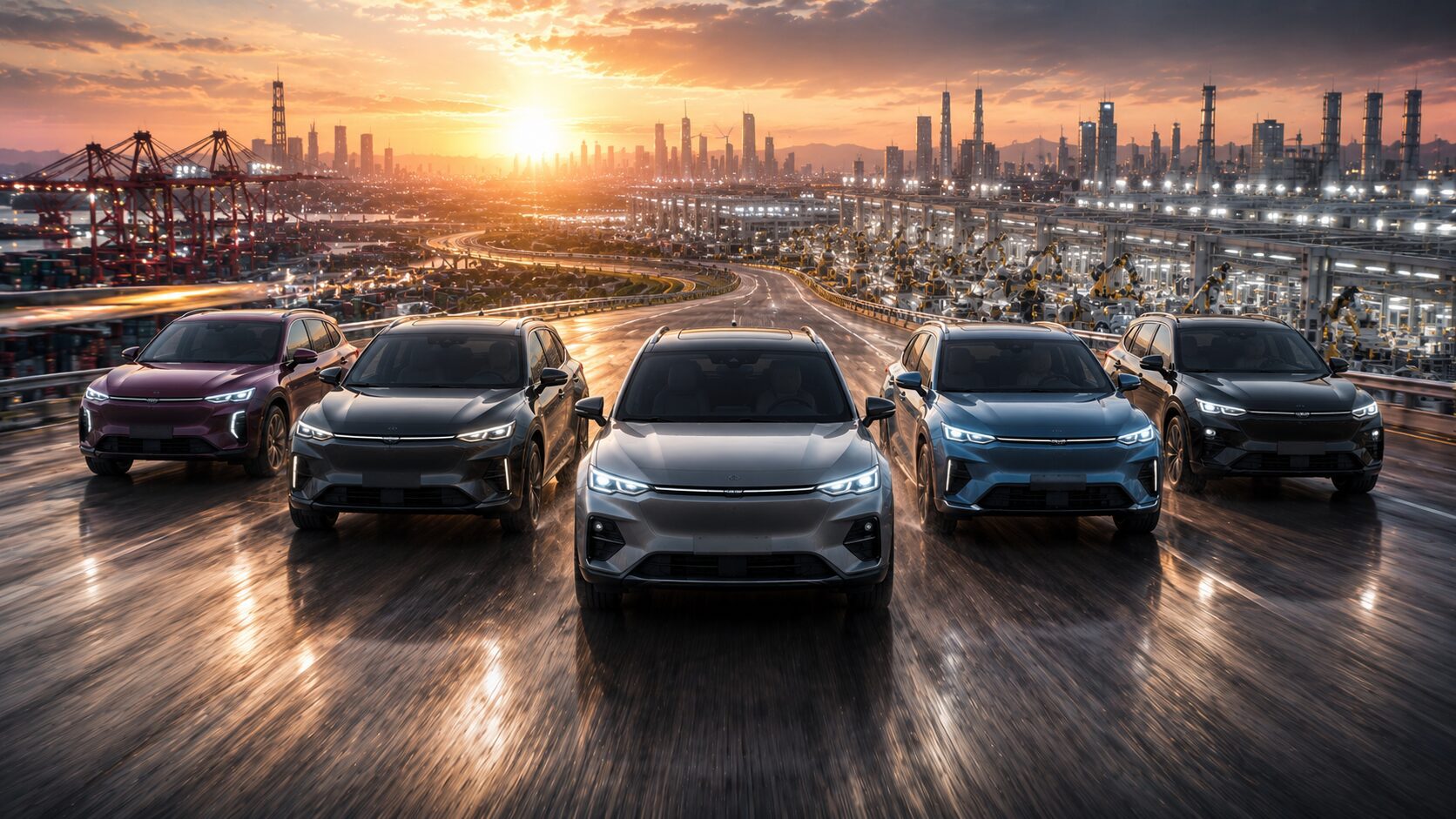
China began incentivizing domestic production of battery-electric, hybrid, and fuel-cell vehicles in 2001, tagged the “863 EV Project”. Over the past decade and to date, the support has encouraged more Chinese companies to enter the market, creating one of the most competitive local automotive industries in the world.
Shanghai-based auto analyst Bill Russo summarized the focused local competition by saying, “They’re not racing the West anymore,” says Russo. “They’re racing each other.”
That competition has triggered what many analysts describe as a price war. As a result, in China, building the premium SUV people want is no longer enough, because manufacturers also have to avoid pricing themselves out of the market.
The domestic price war has become one of China’s biggest competitive advantages abroad because Chinese automotive manufacturers have learned to build feature-rich SUVs at prices many global competitors still struggle to match.
The Legacy Response
Legacy automakers have not ignored what is happening. Several executives have openly acknowledged the challenge, with some even describing it as a crisis. Renault and Stellantis have argued that governments must rethink current regulations if domestic manufacturers are to remain competitive. But government policy is only part of the conversation.
Many legacy manufacturers are already looking inward. Toyota, for example, has seen the need to work more closely with suppliers to improve things. Speaking at a supplier summit, Toyota’s former CEO, Koji Sato, warned, “Unless things change, we will not survive. I want everyone to acknowledge this sense of crisis.” He added, “We must work together as one and strengthen our ability to prevail. To do that, we need to improve productivity across the board.”
Volkswagen CEO, Oliver Blume, has praised China’s execution, saying, “What we experience very positively in China is a high level of discipline and willingness to execute.” He also urged European manufacturers to learn from China’s approach, adding, “It is worth looking beyond our own backyard… we can learn a great deal from how the country has developed.”
Benchmarking Chinese vehicles has quietly become common practice among established automakers. Many executives have traveled to China to study factories firsthand. Jim Farley and his leadership team at Ford even fly some of them back to Detroit to study them.
Renault also appears to be taking lessons from China, as it is already working to reduce vehicle development time, with some future models targeted for completion in just two years.
Chinese automakers have expanded the checklist consumers now work through before deciding which SUV to buy. Heritage and engineering excellence are no longer enough on their own. New SUVs must be feature-rich, offer modern tech, and be affordable. Foreign automakers don’t need to become Chinese automakers. But they may have to learn how to build desirable SUVs faster and produce them more efficiently to stay ahead of the market.
Gabriel Olakunori

Gabriel likes to (blindly) argue that SUVs are part of nature, and he might just have a point when you're walking in the snow, crossing bone-dry deserts, gliding down splendid park-like boulevards, or navigating rocky roads. He has over seven years of experience writing across a broad spectrum of topics, many within the automotive industry. If he is not at the desk w̶r̶i̶t̶i̶n̶g̶ having fun, he is at the wheel d̶r̶i̶v̶i̶n̶g̶ having fun. Either way, the road leads to the same destination: bliss. Gabriel loves SUVs for their all-inclusiveness, but he cannot turn down an offer to drive or write about any vehicle.
